
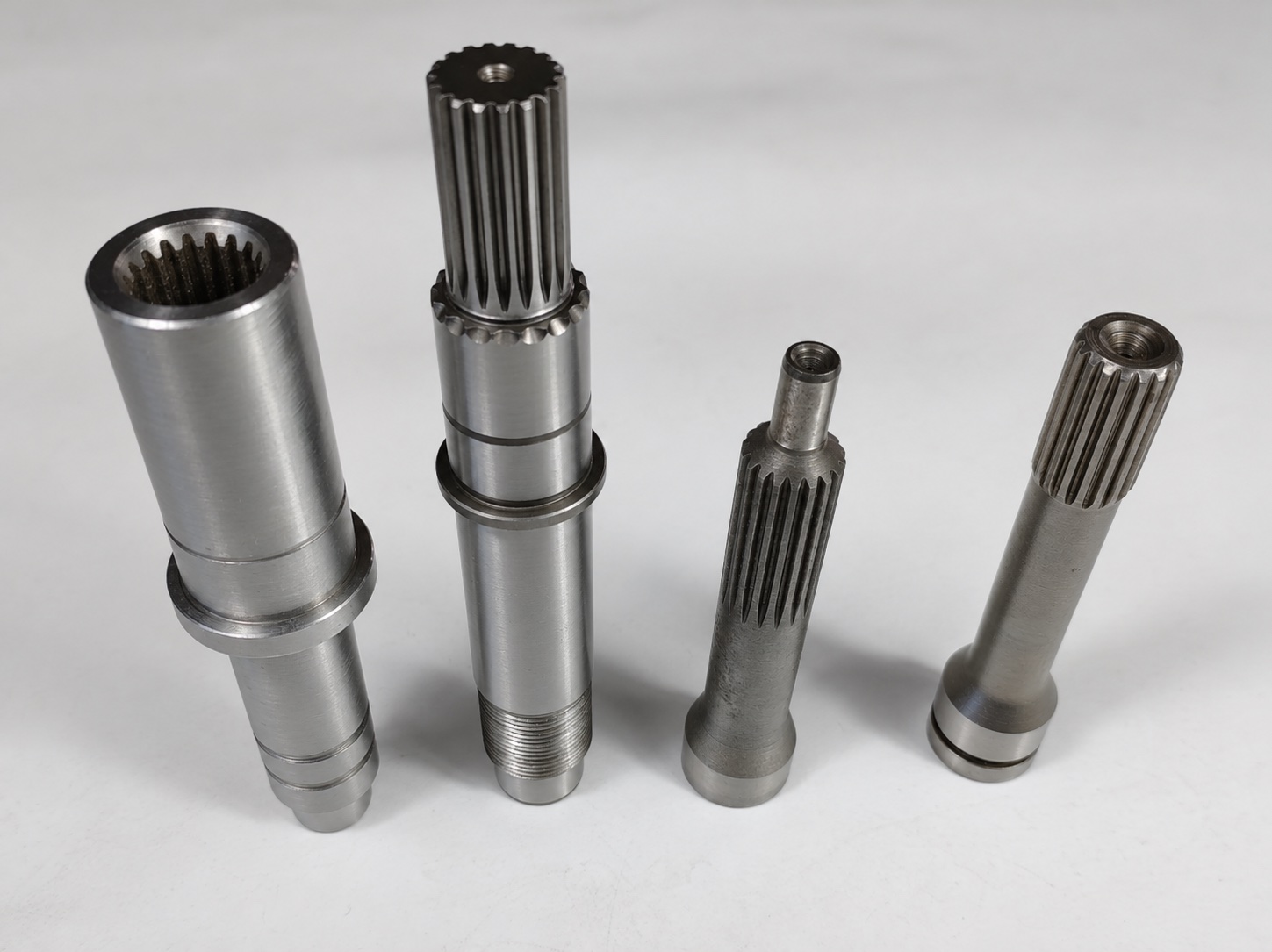
Choosing materials for machined shaft components starts with the shaft’s duty, not a grade name alone. Carbon steel suits many general transmission parts, while alloy steel, stainless steel or a lighter material may be needed for a defined service condition. This guide compares the main choices and explains what to specify before machining begins.
What Shaft Materials Must Withstand
Materials for machined shaft components are selected for the loads at the finished section, the operating environment, and the required condition after treatment. A shaft can carry bending and torque together. Rotation may reverse the bending stress at a surface point, while torsional stress depends on the duty cycle. The load history must therefore be established before fatigue performance is assessed.
Keyways, spline roots, shoulder fillets and surface damage can concentrate stress. A material with a higher tensile strength does not automatically correct a poor transition radius or an unsuitable surface condition. The drawing review should identify these areas and the inspection requirements for them.
Strength is different from stiffness
Most shaft steels have a similar elastic modulus, around 200 GPa at room temperature. Changing from carbon steel to an alloy steel may increase the permitted stress after the specified treatment, but usually changes elastic deflection very little. If the shaft bends too far, review its diameter, unsupported span and bearing arrangement as well as the material.
A hollow section can reduce mass while retaining useful bending and torsional stiffness. At the same outside diameter, however, removing the core reduces stiffness compared with a solid shaft. A larger hollow section can offer a better stiffness-to-mass balance when the assembly permits a larger outside diameter.
Carbon Steel for Machined Shaft Components
Carbon steel is a practical starting point for many general-purpose shafts. The supplied condition matters as much as the grade name: a hot-rolled bar, cold-drawn bar and quenched-and-tempered bar can produce different machining behavior and mechanical properties.
Low-carbon shaft steels
AISI 1018 and 1020 are candidates for lightly loaded pins, locating shafts and selected case-hardened parts. They are relatively soft in common supply conditions, but machinability and chip control still need to be checked. A low-carbon grade can receive a hardened case when the required core properties and treatment specification support that route.
Chinese Grade 20 belongs to a similar low-carbon family. It should not be substituted for 1018 or 1020 without checking the applicable composition limits, product standard and mechanical requirements. General structural grades such as Q235 or ASTM A36 are not automatic alternatives to a specified shaft-quality bar.
Medium-carbon shaft steels
AISI 1045 and Chinese Grade 45 are frequently considered for general transmission shafts. Normalizing, quenching and tempering, or local induction hardening may be selected to obtain the specified condition. The treatment response must be checked against the shaft diameter and the required hardness through the section.
These grades are candidates for stepped shafts and journals where the specified loads and wear conditions can be met without a more highly alloyed steel. They still need corrosion protection where the service or storage environment requires it. Black oxide, for example, provides limited protection and commonly needs supplementary oil or another specified seal.
Avoid assigning a single tensile strength or hardness to every 1045 shaft. Confirm the certified supply condition and section size, then state the acceptance requirement on the drawing or purchase specification.
Alloy Steel for Heavily Loaded Shafts
Alloying can improve hardenability, allowing an appropriate heat treatment to develop the required properties deeper into a section. It does not guarantee that every large shaft will harden uniformly. The steel supplier and heat-treatment provider must confirm the route for the actual diameter and required core condition.
Through-hardening alloy steels
AISI 4140 is a chromium-molybdenum steel used for shafts that need a defined combination of strength and toughness after quenching and tempering. EN 42CrMo4 and Chinese 42CrMo are related grades often reviewed for similar work, but their standards and acceptance limits must be compared before substitution. Chinese 40Cr is a chromium steel and should not be treated as the same material as 4140.
AISI 4340 is a nickel-chromium-molybdenum steel considered for demanding shaft designs. Grades such as 35CrMo and 40CrNi also appear on shaft drawings, but they are separate specifications. A similar intended application does not establish equivalence between them.
Prehardened stock can allow machining in an already treated condition when the required section properties and final surface hardness are available. It may avoid a later quench, but cutting can still release residual stress. Straightness, tool wear and the final size of the journals remain part of the machining review.
Case-hardening alloy steels
Low-carbon alloy steels such as AISI 8620, 20Cr or 20CrMnTi may be specified for a hard wearing surface over a tougher core. AISI 8620 is commonly compared with the 20NiCrMo2-2 family. It should not be treated as interchangeable with 20CrMnTi or 16MnCr5 simply because all can be carburized.
For gear shafts and splined shafts, the drawing should define the case requirement at the working surface and the core properties needed by the shaft. Final grinding is planned where the tolerance and distortion allowance require it; it is not mandatory on every surface of every carburized component.
Stainless Steel for Corrosion-Exposed Shafts
Stainless steel becomes a candidate when cleaning chemicals, moisture or process fluids make an unprotected carbon-steel shaft unsuitable. Selection still needs to account for wear at the journal, the mating component and the operating temperature.
Austenitic stainless shaft materials
304 and 316 are used for selected shafts in equipment exposed to washing or corrosive media. These austenitic grades are not hardened by a conventional quench-and-temper cycle. Cold working can increase strength, so bar condition and the effects of subsequent processing must be understood.
316 generally offers better resistance to chloride-induced pitting than 304, but neither grade is immune to pitting or crevice corrosion. Seawater immersion, stagnant gaps, temperature and cleaning chemicals require a specific corrosion review. A 316 designation alone does not establish suitability for every marine shaft.
The titanium-stabilized grade 1Cr18Ni9Ti should not be presented as a direct equivalent to ordinary 304. Confirm the exact grade on the drawing rather than grouping different stainless specifications under one name.
Hardenable stainless shaft materials
Martensitic grades in the 420 family may be selected where a harder working surface and a specified heat-treated strength are needed. Corrosion resistance and toughness must be reviewed in the final condition. These properties differ from those of austenitic stainless steels.
Surface hardening of stainless steel requires a process suited to the alloy and its corrosion requirement. Conventional high-temperature treatment can affect the corrosion-resistant surface. Specialized low-temperature treatments or coatings may be considered after a review of fit, case properties and service conditions.
Other Materials for Machined Shaft Components
Steel is not the only option for shaft components, but a different material family changes more than the part weight. The design must be checked for stiffness, fatigue, wear and the way the shaft connects to its mating parts.
Ductile iron for cast shaft forms
Ductile iron can be considered for complex crankshaft or camshaft designs where a casting route is appropriate. Chinese grades such as QT400-15 and QT600-3 identify different property requirements; the casting standard, section size and matrix condition must be specified.
Graphite morphology, casting soundness and fillet design affect performance. Do not assume that all camshafts are ductile iron or that a casting has the same fatigue behavior as a forged steel shaft. The material and blank route need to be validated for the actual duty.
Aluminum for weight-sensitive shafts
2024 or 7075 aluminum may be considered for selected lightweight shafts, instrument components or low-inertia mechanisms. Lower density reduces mass, but the elastic modulus is substantially lower than steel. Diameter, bearing fit, thermal expansion and wear protection need to be checked before replacing a steel design.
Aluminum is not a blanket choice for a high-speed spindle, nor is it automatically unsuitable for every power-transmission shaft. The decision follows the load calculation and the design of the complete assembly.
Titanium for specialized shaft components
Ti-6Al-4V offers a lower density than steel with useful strength and corrosion resistance. Typical room-temperature density is about 4.4 g/cm³ and elastic modulus is approximately 107–122 GPa, depending on condition and texture. It is therefore significantly less stiff than steel at the same geometry.
For a specialized titanium shaft, machining heat, tool wear and galling at contact surfaces must be reviewed. A weight benefit does not remove the need to validate fatigue behavior and the required journal surface.
Choosing Stock for Shaft Machining
Bar stock is suitable for many straight shafts and parts with modest changes in diameter. The selected size must leave enough stock to remove the original surface and recover straightness. Cold-drawn bar can offer closer starting dimensions, but its residual stress can cause movement when material is removed unevenly.
A forging may be selected for a large or highly loaded shaft, or when the specified material quality and grain-flow requirements call for it. The forging specification should define the relevant reduction, heat-treatment condition and inspection acceptance. Neither a fixed forging ratio nor a nondestructive test standard should be copied to every shaft without reviewing the design.
A cast blank may reduce machining for complex shaft forms, provided casting quality and material properties meet the requirement. A hollow blank can reduce material removal when an axial bore is part of the design; wall thickness and internal quality must also be checked.
Plan the locating method while choosing the stock. The process has to leave usable datums through turning, treatment and final inspection. Our guide to planning the shaft manufacturing process explains how these operations are sequenced.
Specifying Shaft Materials for Production
A production specification combines the material grade with its condition and the requirements for the finished surfaces. Start with the calculated duty and corrosion environment, then confirm that the available stock and treatment route can meet those requirements.
Plan surface hardening before final sizing
Carburizing gives a suitable low-carbon steel a carbon-enriched case that is hardened by the subsequent treatment. The specification must state surface hardness, effective case depth and any core requirement. Quench distortion and the stock needed for final grinding are considered before rough machining.
Nitriding can produce a hard surface on a suitable grade without a subsequent hardening quench. 38CrMoAlA is one example of a nitriding steel used for specified wear-resistant shaft surfaces. Lower distortion does not mean zero dimensional change: growth, residual stress and any permitted finishing must be included in the plan.
Carbonitriding and ferritic nitrocarburizing are different processes. Ferritic nitrocarburizing, sometimes called soft nitriding, produces a shallow treated layer; it should not be described as simply a softer version of a carburized case. Layer depth, hardness measurement and the acceptance method must match the selected treatment.
Control the finished surface
Shot peening and roller burnishing may introduce beneficial compressive residual stress when an approved process is suitable for the part. They do not repair existing cracks or replace inspection. Coverage, surface roughness, protected areas and dimensional effects must be controlled.
Induction hardening can be selected for defined journals or other working surfaces on a suitable steel. The drawing should identify the hardened area, required depth and hardness, including how the transition to untreated material will be handled.
State what the supplier must verify
For a machined transmission shaft, provide the material standard and grade, stock form, supply condition and required treatment. Identify the bearing seats, splines and other critical interfaces. State the finished hardness, any effective case depth, and the locations where they will be checked.
Add the required material certificate and dimensional or treatment records to the order. A grade name alone does not define a finished shaft. We review these requirements with the drawing before setting the machining and inspection sequence.
** Material names and values in this article are selection references. Confirm the applicable standard, certified condition, section size and drawing requirements before approving a material or substitution.