
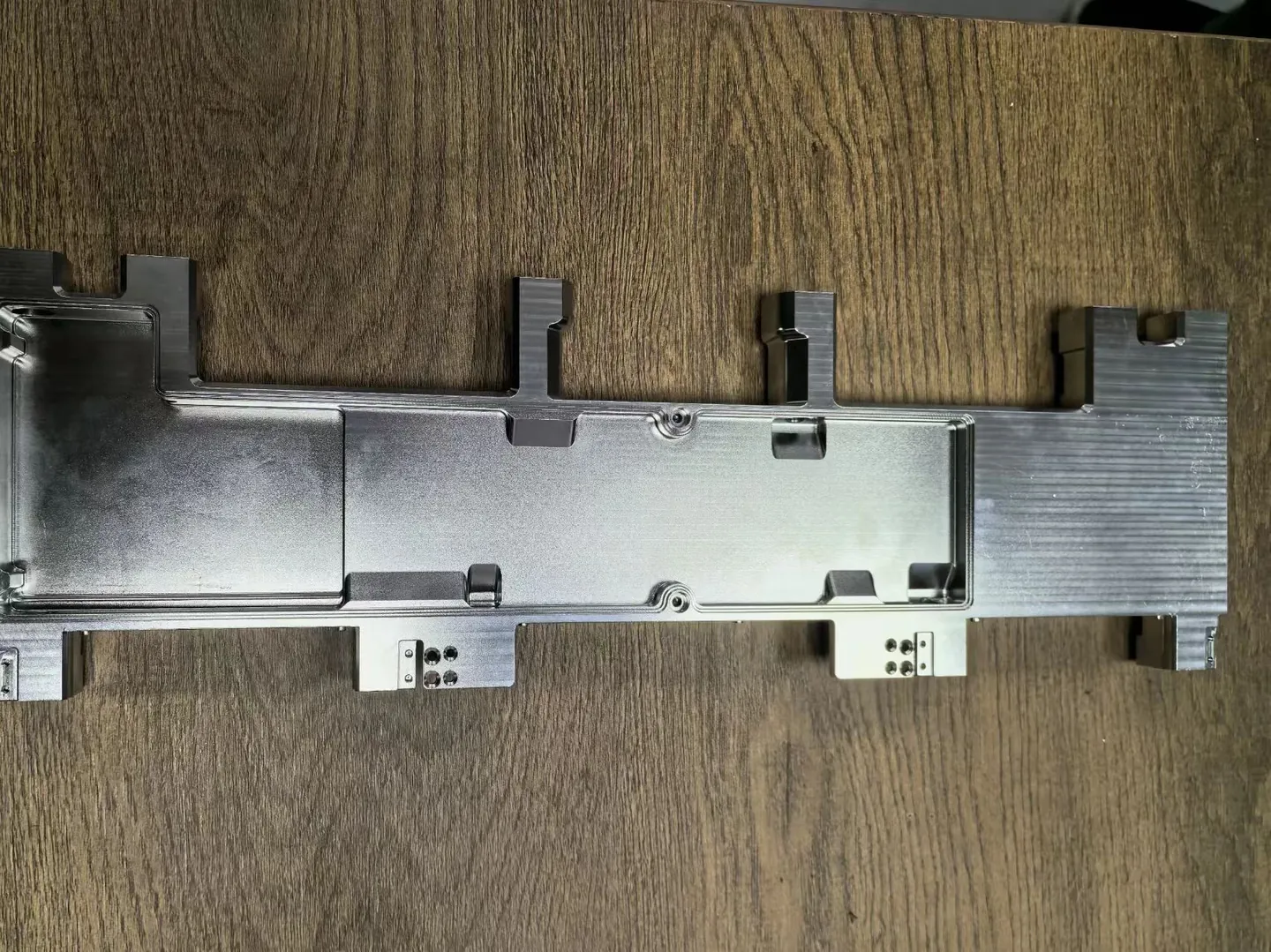
Vacuum-Brazed Cold Plate
Internal fins and channels are enclosed through controlled brazing for high heat-transfer area and compact flow paths.
We engineer and manufacture liquid cooling cold plates around your heat load, flow target, pressure drop, envelope, mounting pattern, sealing method, and production volume. Our team connects thermal requirements with a practical machining, joining, finishing, inspection, and leak-testing route.
A cold plate is not only a machined block with channels. Channel geometry, contact flatness, coolant compatibility, port position, sealing, joining method, pressure capability, and installation load all influence performance. We review the full assembly before selecting the manufacturing route.
For prototypes, we help identify the fastest construction that can validate thermal and hydraulic behavior. For production, we focus on repeatable channel geometry, controlled joining, traceable leak testing, clean internal passages, and stable mounting interfaces.
We select the construction method according to heat flux, pressure, channel complexity, cleanliness, material, joining risk, and expected production volume.
Internal fins and channels are enclosed through controlled brazing for high heat-transfer area and compact flow paths.
A machined channel cover is joined with low distortion and no filler metal, supporting strong aluminum thermal assemblies.
Copper or stainless tubing is embedded into a machined aluminum plate for practical routing and fluid isolation.
Intersecting drilled passages create sealed internal circuits for robust blocks, manifolds, and compact tooling plates.
We start with the heat source and assembly, then work inward toward the flow path. This keeps thermal performance, pressure integrity, manufacturability, and inspection connected.
We review heat flux, component footprint, thermal interface material, mounting load, and allowable temperature rise.
Channel width, depth, turns, fins, inlet distribution, and coolant viscosity are balanced against pump capability.
O-ring grooves, cover plates, brazed joints, weld paths, ports, and pressure boundaries are reviewed together.
Machining sequence, joining heat, finishing thickness, mounting pattern, and final inspection affect contact flatness.
We match thermal conductivity, corrosion behavior, coolant chemistry, weight, joining compatibility, and finish requirements to the operating environment.
Our common choice for machinability, low mass, thermal performance, anodizing response, and broad material availability.
Selected where very high thermal conductivity justifies additional weight, cost, and surface-protection considerations.
Used for corrosion resistance, pressure hardware, fittings, and applications where coolant compatibility is critical.
Anodizing, electroless nickel plating, passivation, conversion coating, and selective masking are reviewed against the coolant loop.
We define inspection and testing before production so critical thermal, hydraulic, and assembly features remain connected to the drawing.

We manufacture custom cold plates for systems where thermal density, package size, reliability, and serviceability demand a controlled liquid path.
Cold plates, manifolds, and interfaces for CPUs, GPUs, accelerators, and high-density server platforms.
Cooling plates for IGBT modules, inverters, converters, chargers, and energy-storage systems.
Temperature-control hardware for process tools, vacuum equipment, test systems, and precision stages.
Compact liquid cooling for lasers, imaging equipment, laboratory instruments, and automated machinery.
Send us your drawing, material, quantity, and quality requirements.
We’ll help define the next step.